Small Room, Full Day: Photographing a Register Office Wedding Without the Stiffness
Most wedding photography advice quietly assumes a long aisle, a big venue and hours of getting-ready photos to fill the morning. A UK register office wedding doesn't work like that. The ceremony might be twenty minutes, the room might be needed for the next couple at half past, and your guests may be standing on a pavement outside a town hall wondering where to put their coats. None of that makes the day less of a story. It just means the story lives in smaller windows.
The room is not a cathedral, and that's fine
Council chambers and register office rooms come with their own character: heavy doors, a desk for the registrar, a few rows of chairs, a carpet that has seen every kind of wedding, and possibly a fire exit sign directly behind where you'll say your vows. You can fight that, or you can let it be part of the day.
Practical bit first: ask the council about photography rules when you book, not on the morning. Some register offices are relaxed about a photographer moving quietly at the side; others ask you to stay in one spot or skip photos during the legal bits. Ask where you can stand, whether flash is allowed, and whether confetti is permitted outside. It saves an awkward conversation with a superintendent registrar while your guests are already seated.
If the room is small, don't try to hide it with extreme wide shots. A slightly wider frame that shows the witnesses, the registrar and the odd stack of chairs can feel more honest than a tight crop that pretends you're in a country house. The aim is not to make a register office look like somewhere else. It's to photograph the room you actually got married in.
The waiting room is part of the day
There's usually a limbo bit before a civil ceremony: people arriving in twos, checking phones, reading the noticeboard, adjusting a tie, quietly asking whether this is the right door. It can feel like a holding pen, but it's often where the nerves show and where the real moments happen.
A good photographer will use ten or fifteen minutes here without making anyone perform. Hands fidgeting with a ring box. A grandparent being helped out of a coat. A couple standing slightly too far apart because they're both pretending not to be nervous. These are the photographs that remind you what the day felt like, not just what it looked like.
Tell your photographer who matters and who might need a heads-up. If someone is shy, or if there's a family dynamic that doesn't need to be captured in high definition, say so. A short ceremony leaves less time to recover from surprises, so a little honesty beforehand goes a long way.
The walk in is short — so don't rush it
In a register office there may be no aisle at all, just a doorway and a few steps. That's exactly why the entrance deserves a plan. If you're walking in together, agree on a small pause at the door: look at each other, take a breath, then go in. If you're walking in with a parent or friend, tell them where to stop so the registrar knows you've arrived. It sounds fussy, but it gives the moment a shape.
For photographs, the walk in is less about a grand reveal and more about faces. The couple's faces, yes, but also the guests turning round, the witness who catches your eye, the person who forgets to stop smiling. A photographer standing slightly to the side near the front can catch that without blocking anyone's view. If the room is tight, they may need to stay near the back and shoot between heads. That's okay. A documentary photograph with a bit of a shoulder in the frame is often better than a perfectly clear one that stops the ceremony.
Vows are brief, reactions are not
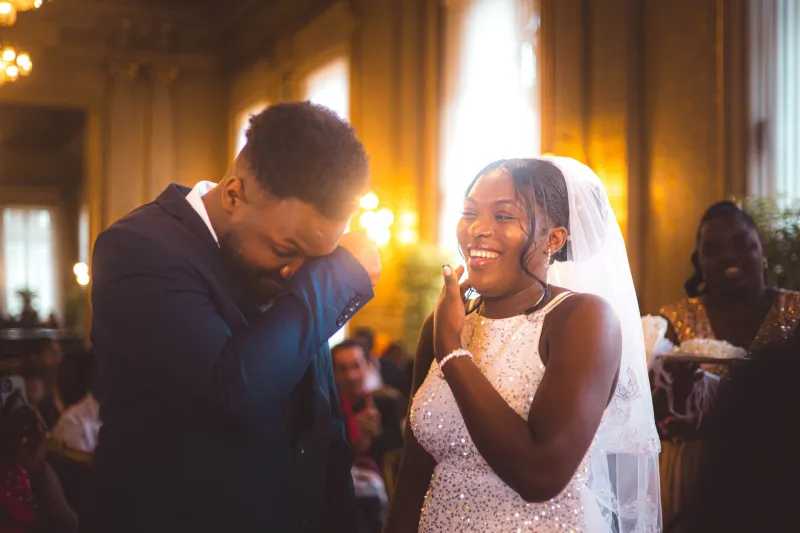
Civil ceremonies are legal, which means some of the words are fixed. You may not have written personal vows, and the ring exchange might be over before your guests have settled. The photographs that carry the day are usually the ones around the edges: hands, rings, the registrar's expression, a parent's face, a child whispering, a friend trying not to cry.
The register signing is often the most staged part, because councils have their own rhythm for it. Keep it quick and keep it warm. If the registrar suggests a photo-friendly pause, take it, but don't turn the desk into a photo booth. The best signing photos usually include the witnesses leaning in and someone's sleeve knocking a pen off the table.
The exit is over in seconds — plan the pavement
Before you know it, you're married, the registrar is congratulating you, and everyone is heading for the door. The exit can be lovely, but it's also the bit most likely to dissolve into a car park conversation about where to get lunch.
If confetti is allowed, check where and when. Some councils only permit it in certain outdoor spots, and some don't permit it at all. If it's not allowed, don't mourn it. A line of guests throwing nothing but cheering is still a good photograph. If it is allowed, ask a friend to hand out cones and tell people to throw high, not in faces.
Group photos on the steps can work, but keep them to ten minutes and keep the list short. A register office wedding doesn't need forty formal combinations. It needs the people who were actually there, photographed before they get cold. Then let everyone drift towards the pub, the park or the bus stop. The in-between bit — walking down a high street, crossing at the lights, sheltering under a shop awning — is often where the day starts to feel like yours.
The pub around the corner is the reception
If your reception is in a pub, embrace it. Pints, crisps, a dog under the table, children running between chairs, someone's uncle holding forth by the fruit machine. A register office wedding often has a built-in intimacy because there's nowhere to hide and no grand staircase to descend. The photography should match that.
Tell your photographer where you're going next and how long the walk takes. If the pub has a dark corner or a bright window, mention it. Landlords are usually happy for a photographer to work quietly as long as they're not blocking the bar.
A realistic timeline for a short ceremony
A simple shape might look like this: arrive at the register office twenty minutes before, use ten minutes for waiting-room photographs, head in for the ceremony, allow twenty-five minutes for the legal bits and signing, spend ten minutes on the steps for hugs and a few group photos, then walk to the pub for twenty minutes. That's barely an hour and a half, but it can hold a whole day's worth of feeling if you don't overpack it.
Build in a buffer. Council ceremonies run to time, and the one thing you can't do is ask the next couple to wait while you get a second exit shot.
What to tell yourselves
A short ceremony does not mean a short story. It means the story is closer to the surface: the nerves in the waiting room, the pause at the door, the friend who cries during the legal vows, the walk to the pub with your shoes already hurting. You don't need to manufacture anything. You just need to leave a little room around the legal bit, and let the day happen in the small spaces either side.