The Front Row Is Not a Stage: Seating Choices That Keep Ceremony Moments Honest
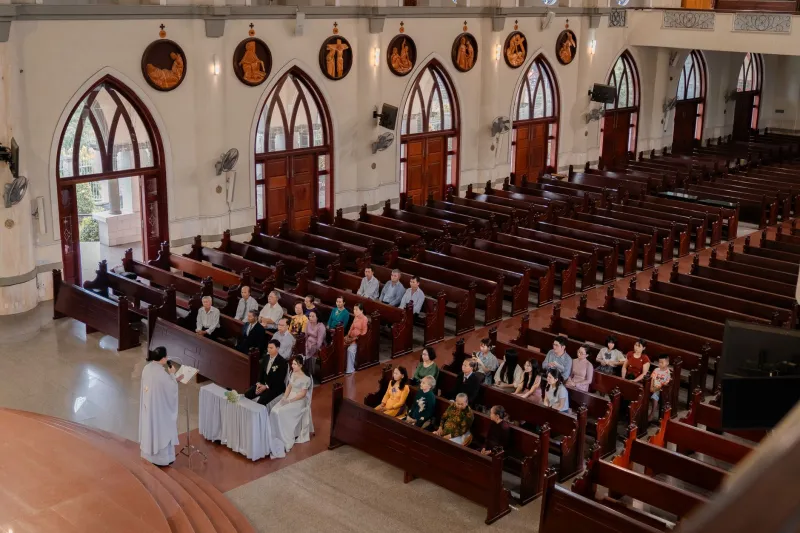
Ceremony seating looks like admin. A list of names, a few reserved rows, a quick word with the venue coordinator, done. But seating quietly decides what your guests can see, what your photographer can catch, and how the room feels when the music starts. None of that needs to become a production. In fact, the best seating plans tend to be the ones that disappear.
Start with sightlines, not symmetry
Most UK ceremony rooms are not blank canvases. Churches have pillars, pews and side aisles. Barns have posts and low beams. Registry offices have fixed furniture and a very particular idea of where everyone stands. Marquees have poles, drapes and a wall that might be doing more visual work than you expect.
Before you worry about who sits next to whom, stand at the back of the room and look towards the ceremony focal point. Then sit in a few seats. Can you see the couple? Can you see the celebrant or registrar? Is there a column cutting the room in half? Are the front-row guests craning around a candelabra?
A good seating plan gives people a clear line of sight without making the room look like a theatre. You do not need perfect symmetry. You need enough gaps, enough angle and enough breathing room that guests can turn their heads naturally rather than lean into the aisle like they are watching a sports final.
The aisle seat is a viewing point
Aisle seats are the ones your photographer will spend a lot of time near, because they are where reactions happen. A parent catching their first glimpse. A grandparent doing the tiny lip wobble. A friend who has known you since school and cannot quite believe you are here.
That does not mean you should plant the most emotional people in the aisle like a row of extras. It means thinking about who will be comfortable there. Guests who are happy to be visible, who will not feel exposed, and who can see the ceremony without twisting. If someone is shy, put them a seat or two in. They will still be part of it.
Children are a slightly different matter. An aisle seat can be brilliant for a quick exit if a toddler decides the ceremony has gone on long enough. It can also be a distraction if they are determined to make a break for the altar. Think about the practicalities: buggies, snacks, toys, and the nearest door. The back row is not a punishment. It is often the most sensible place for a wriggly little one and the adult who is on duty.
Family politics without a spreadsheet
This is the part where seating plans can get tense. Divorced parents, stepfamilies, estranged relatives, plus-ones who know nobody, and the cousin who has strong opinions about being nearer the front. You do not need to solve every family dynamic on a piece of paper, but you do need to be honest about the room.
If two guests are better off not sharing a pew, do not put them in one and hope for the best. Use a neutral row, a friendly usher and a bit of quiet diplomacy. Reserved rows can help, but only where they are genuinely needed. Too many reserved seats and the front of the room starts to feel like a VIP section. Too few and your nan is standing at the back wondering where to put her handbag.
Keep reserved signage subtle. A small card or a ribbon is plenty. Ask your ushers to know the plan and to seat people with a smile rather than a clipboard. The aim is for guests to arrive, find a spot and settle, not to feel they are being auditioned for a role in the day.
Windows, pillars and the light you did not plan
In the UK, ceremony light is rarely predictable. A south-facing window can be beautiful in December and slightly brutal in July. A church window might cast colour across the aisle. A marquee wall can glow like a lantern or turn into a white backdrop that swallows everyone in front of it.
You do not need to become a lighting technician. Just think about where people will be sitting relative to the light. If a row of guests will be in deep silhouette, it is worth mentioning to your photographer before the day. They can adapt, move and choose a different angle, but a little local knowledge helps.
Tall guests, big hats and elaborate hair can also block a view. That is not a reason to ban hats. It is a reason to leave a bit of space between rows and to avoid packing the front row so tightly that nobody can shift. A few extra inches can make all the difference between a guest seeing the vows and a guest seeing the back of someone's head.
The back row is not a sin bin
Latecomers, babies, fidgeters, elderly guests who might need to slip out, and people who simply prefer the edge of the room will often end up at the back. That is fine. The back row is a useful place to be. It is close to the door, close to the exit and close to the loos. It can also be a lovely spot for a quiet guest who wants to take it all in without feeling watched.
What you want to avoid is cramming everyone into the middle and leaving the back row looking like a forgotten corner. Spread people out a little. Leave a few spare seats. Let the room feel like it has space to breathe. If your venue has fixed pews, work with what you have and ask the coordinator where extra chairs can go if numbers creep up.
Tell your photographer the plan, then let it go
A quick note to your photographer about the seating plan is genuinely useful. Not a diagram of every guest, but the useful bits: who matters most, where the reserved rows are, whether one side of the family is travelling from abroad, and if there is anyone who might need a quiet word or a clear exit.
What you do not need to do is choreograph reactions. You cannot seat a perfect emotional moment into existence. The best ceremony photographs happen because people are comfortable, can see, and have forgotten about the camera. Your job is to give them a decent view and a bit of room. My job is to stay out of the way and pay attention.
So treat the seating plan as a practical map, not a stage set. Sit in a few chairs, check the sightlines, look after the people who need looking after, and leave the rest to the day. The room will do the talking.